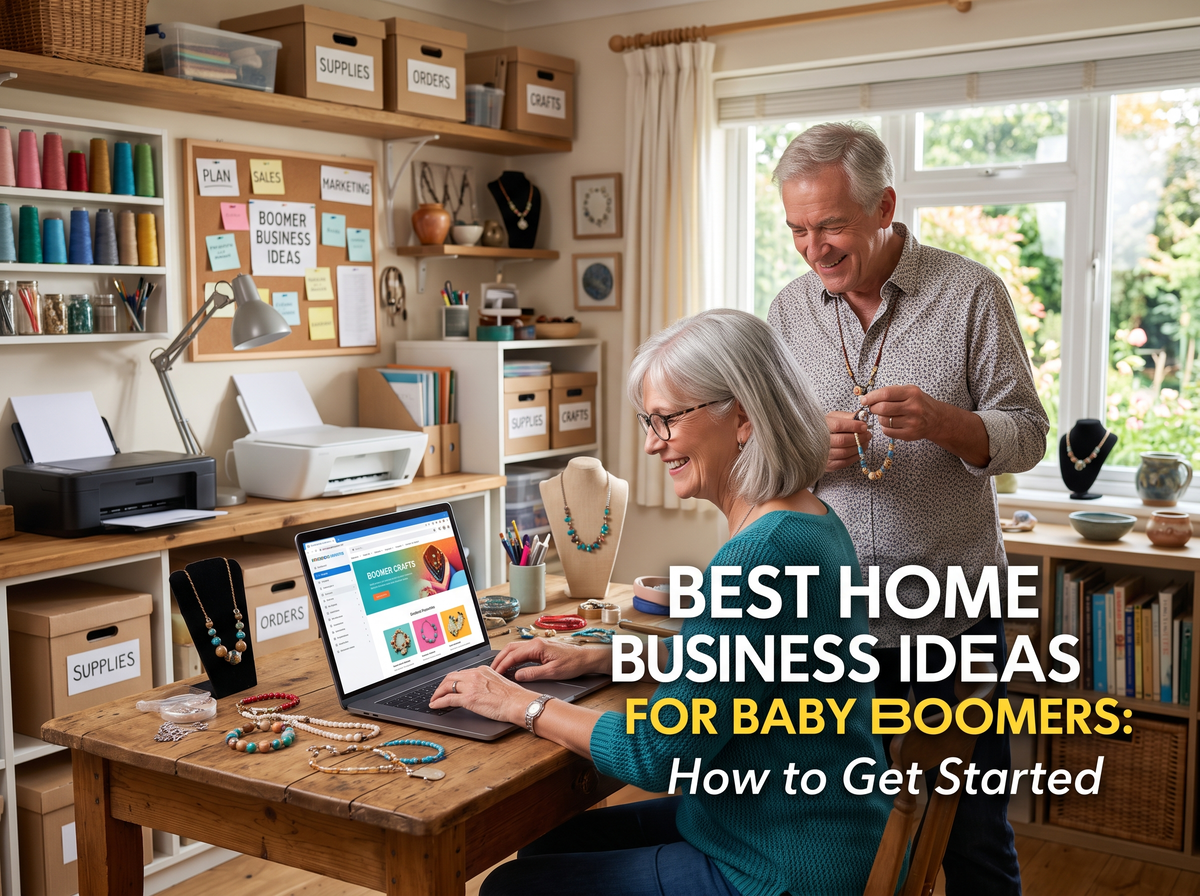
Retirement was supposed to be the finish line. But for many baby boomers, it turns out to be more of a starting gun.
Whether it’s the desire for extra income, the itch to stay productive, or simply the realization that sitting still isn’t in their DNA, retirement can be an opportunity to build something of your own. And starting a home business doesn’t necessarily mean risking your savings, renting office space, hiring employees, or working 60-hour weeks.
Some of the best home business ideas for baby boomers can be started gradually, with relatively low overhead, right from home. More importantly, baby boomers have something younger entrepreneurs simply can’t manufacture overnight: decades of experience.
The skills, relationships, knowledge, and judgment you’ve accumulated throughout your working life can become valuable business assets. Here are some of the best ways to put them to work.
Why Baby Boomers Are Well Positioned to Run Home Businesses
There’s a common misconception that entrepreneurship belongs to the young. But experience can be a tremendous advantage in business.
After decades in the workforce, many baby boomers have developed professional expertise, communication skills, industry knowledge, personal networks, and the ability to solve problems without panicking when something doesn’t go according to plan. Those qualities matter when you’re building a business of your own.
You may also be in a position where you don’t need to replace an entire career salary. A home business that generates supplemental monthly income can still make a meaningful difference while giving you flexibility over when, where, and how much you work.
Then there’s the knowledge factor. Someone who spent 30 years in healthcare, finance, education, management, sales, skilled trades, or another profession has expertise that other people may be willing to pay for.
The question becomes: How can you turn what you already know — or something you already enjoy — into a business?
Here are several possibilities.
Consulting and Coaching: Turn Your Experience Into Income
One of the most natural home businesses for baby boomers is consulting or coaching based on previous professional experience.
A retired HR director might help small businesses improve their hiring and employee-management processes. A former executive might coach new managers or entrepreneurs. A retired teacher could tutor students, provide educational consulting, or create courses based on a subject they’ve taught for years. Someone with decades of sales experience could help small businesses improve their sales process.
The possibilities are almost endless because you’re starting with knowledge you already possess. Startup costs can also be relatively low. Depending on the business, you may need little more than a professional website, email, a scheduling system, and video conferencing software.
The key is usually specialization. Instead of marketing yourself simply as a “business consultant,” consider exactly who you can help and what problem you can solve for them. The more clearly you can answer those two questions, the easier it becomes for the right potential clients to recognize your value.
Freelance Writing, Editing, and Content Creation
If you’re a strong writer or communicator, freelance work can be one of the easiest home businesses to begin. Businesses need website content, blog posts, newsletters, email campaigns, product descriptions, training materials, technical documentation, and marketing copy. Authors and publishers also need editors and proofreaders.
Your previous career can give you an advantage here as well. For example, someone with a background in healthcare may be better positioned to write healthcare-related content than a general freelance writer. The same is true for finance, education, technology, real estate, construction, travel, and countless other industries.
Content creation doesn’t have to stop with writing. Photography, video, podcasts, online courses, tutorials, and educational YouTube channels can all become parts of a home-based business.
Your age can actually be an advantage. You don’t need to pretend to have experience. You have it.
E-Commerce and Handmade Goods
If you enjoy making things, collecting things, or finding undervalued products, e-commerce opens another door. Online marketplaces make it possible to sell handmade goods, collectibles, vintage items, artwork, clothing, jewelry, woodworking projects, craft products, and countless other items without operating a traditional retail store.
For someone who already enjoys woodworking, quilting, jewelry making, sewing, painting, or another craft, a hobby can potentially develop into a small business.
Reselling is another possibility. Someone with a good eye for antiques, collectibles, tools, furniture, or other products may be able to find undervalued items locally and sell them online to a much larger audience.
There is a learning curve. Good photographs, accurate descriptions, sensible pricing, customer service, packaging, and shipping all matter. But you don’t have to build a massive operation on day one.
Start with a few products. Learn what sells. Improve your process. Then decide whether you want to grow.
Virtual Assistant and Administrative Services
The growth of remote work has also created opportunities for people who are skilled at keeping businesses organized. Entrepreneurs and small business owners often need help managing email, scheduling appointments, responding to customers, organizing information, updating websites, preparing documents, coordinating projects, or handling other administrative tasks.
That creates an opportunity for virtual assistants. This can be an especially natural transition for baby boomers with backgrounds in administration, office management, bookkeeping, customer service, project management, or executive support.
You don’t necessarily have to be a general virtual assistant, either. Specialized skills can make your service considerably more valuable. Someone with bookkeeping experience might specialize in helping small businesses keep their records organized, while someone from the legal or medical field might focus on businesses where familiarity with that industry is useful.
One advantage of this business model is the potential for recurring clients. Instead of constantly finding another one-time project, you may be able to work with the same clients month after month.
Affiliate Marketing and Online Business
There’s another category of home business that’s particularly attractive if your goal is to build something that isn’t entirely dependent on exchanging your time for money.
An online business can allow you to create content, recommend products and services, build an audience, and earn affiliate commissions when people make purchases or join programs through your recommendations. This business model is known as affiliate marketing.
For example, imagine you’ve spent years gardening. You could build a website around gardening tips, publish useful articles based on your experience, recommend products you genuinely find helpful, and potentially earn commissions when readers purchase those products through your affiliate links.
The same model can be applied to travel, golf, cooking, personal finance, hobbies, home improvement, technology, pets, health and fitness, business, and thousands of other subjects. You don’t have to manufacture a product, maintain inventory, pack boxes, or provide the underlying service yourself. Your job is to connect the right people with useful information and relevant products or services.
That doesn’t mean affiliate marketing is instant or effortless income. Building a useful website, attracting visitors, developing trust, and learning online marketing all take time.
But it offers something many traditional home businesses don’t: the opportunity to build an online asset that can continue working even when you’re not sitting at your computer.
For baby boomers who want to learn how an online business works but don’t want to figure out every piece from scratch, a step-by-step business system can also make the learning curve easier.
What Should You Look for in a Home Business?
With so many possibilities, choosing the right business matters more than choosing the most exciting-sounding opportunity. Start by asking yourself a few questions.
What skills do you already have? What do people regularly ask you for help with? What subjects could you happily talk about or work on for years? How much money are you comfortable investing? Do you want to work directly with clients, sell products, or build something online? How many hours do you actually want to work?
And perhaps most importantly, what do you want this business to do for your life?
Someone who wants an extra $500 or $1,000 per month has a very different goal from someone trying to replace a full-time salary. There’s nothing wrong with either objective.
The business should fit your life — not the other way around.
Getting Started Without Getting Overwhelmed
For many people, the biggest obstacle isn’t capability. It’s the feeling that starting a business is complicated.
Don’t make it more complicated than it needs to be. You don’t need a perfect logo, elaborate business plan, expensive office, or dozens of products before you begin.
Start by choosing one business model. Determine who you can help or what you can sell. Research the basic legal, tax, licensing, and insurance requirements that apply to your particular business and location. Then concentrate on reaching your first customer.
For a service-based business, your existing personal and professional network can be one of your greatest advantages. Former colleagues, friends, neighbors, business contacts, and community connections already know something about you. Depending on the service you’re offering, those relationships may provide your first customers, referrals, or introductions.
One paying customer can teach you more about your business than weeks spent trying to make everything perfect before launching. Start small, learn, improve, and then grow.
Staying Competitive in a Digital World
Technology can feel like the intimidating part of starting a modern home business, particularly if you didn’t spend your career working online. Don’t let that stop you.
You don’t have to become a programmer or technology expert. Most home businesses need a relatively small collection of digital skills: email, web browsing, video calls, basic website management, online payments, and perhaps simple bookkeeping, design, or marketing software.
Learn one tool when you need it rather than trying to master everything at once. There are also more resources available than ever before to help you learn, including software tutorials, online videos, community programs, and organizations that provide guidance to small business owners.
Technology is a tool. Your experience is the asset.
What to Avoid When Starting a Home Business
Unfortunately, people looking for ways to earn money from home are also frequent targets for exaggerated business opportunities and get-rich-quick promises. Be skeptical of anyone promising large amounts of money with little work, guaranteed earnings, or instant success.
A legitimate business requires something of value. You may be providing expertise, performing a service, creating content, selling products, or connecting buyers with products and services through affiliate marketing.
Whatever model you choose, there should be a clear answer to a simple question: Where does the value come from?
You should also be cautious about investing large amounts of money before you’ve proven that you enjoy the business and that there is genuine demand for what you’re offering. One of the advantages of many home businesses is that you can test the idea on a small scale before making a major commitment.
Turning Experience Into Your Next Chapter
The best home business ideas for baby boomers aren’t necessarily exotic or complicated. In many cases, they’re built on something you already possess: experience, knowledge, relationships, skills, interests, and the willingness to learn something new.
Consulting, freelance writing, e-commerce, virtual assistance, affiliate marketing, and other online businesses all offer different paths. The right choice depends on your experience, personality, financial goals, and the kind of life you want to create.
You don’t need to know exactly where the business will be five years from now. You only need to identify a promising direction and take the first meaningful step.
Choose one idea that fits your strengths. Find out what it would take to land your first customer, make your first sale, or earn your first commission. Then start.
Your working years may have given you the experience. Your next chapter gives you the opportunity to decide what you want to do with it.
Derrick Coleman shares practical tips, tools, and resources to help make building income online simpler and more approachable. Through this website, Derrick provides helpful content and recommendations, including the Plug-In Profit Site, a system designed to help beginners get started online with a website, step-by-step training, and built-in income streams. Learn more about getting started with Plug-In Profit Site here.
Before you go...
Want a proven way to start building online income? Join free to get step-by-step guidance plus a ready-to-use website so you can start earning with confidence.
No hype. No nonsense. Real help.